Independent visitor guide · Tashkent, Sergeli

The Buddhist Temple in Tashkent: Jaeunsa

The only active Buddhist temple in Central Asia sits just beyond the ring road, south of the airport, beneath an elevated metro line. How to find it, when to come, how to behave, and what you will see there.

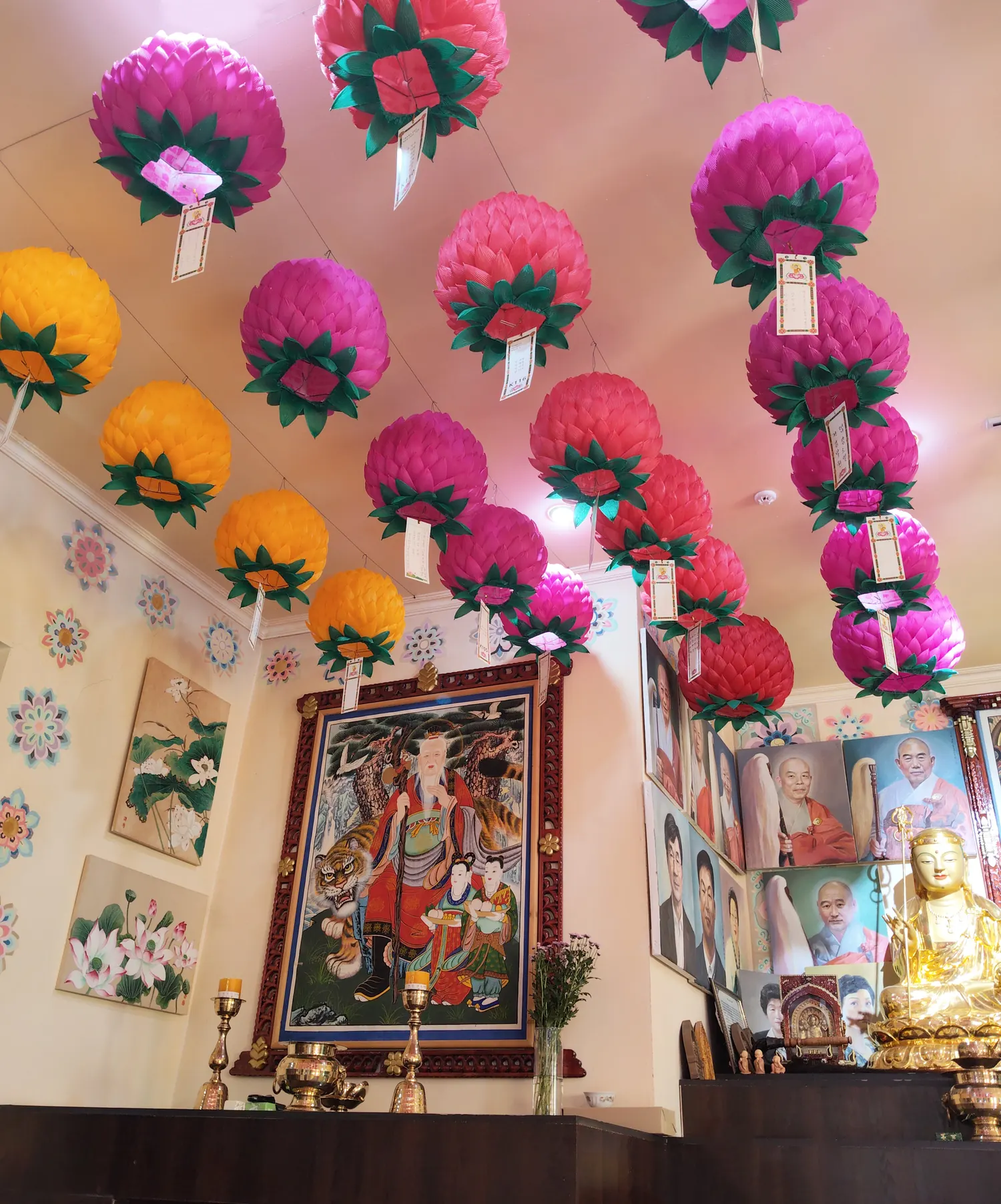
Colourful paper lanterns beneath the ceiling of Jaeunsa Temple in Tashkent
Lanterns beneath the ceiling of the main hall · photo: Jaeunsa Temple
1

active Buddhist temple in all of Central Asia

1990s

the community has been in Tashkent; in the current building since 2016

Sun

service day, followed by a shared meal

100+

people gather for the major holidays

Getting there

Beyond the TKAD, south of the airport. Look for the elevated metro.

From the centre it is half an hour by car or an hour by bus. The temple is small and sits in a residential neighbourhood of private houses — a map app will bring you right to the gate, and it is a few minutes’ walk from the bus stop.

Buses 37 and 40 run along the ring road; airport buses 11 and 77 go to the airport, then walk or take a taxi. A taxi from the centre takes 25–40 minutes.

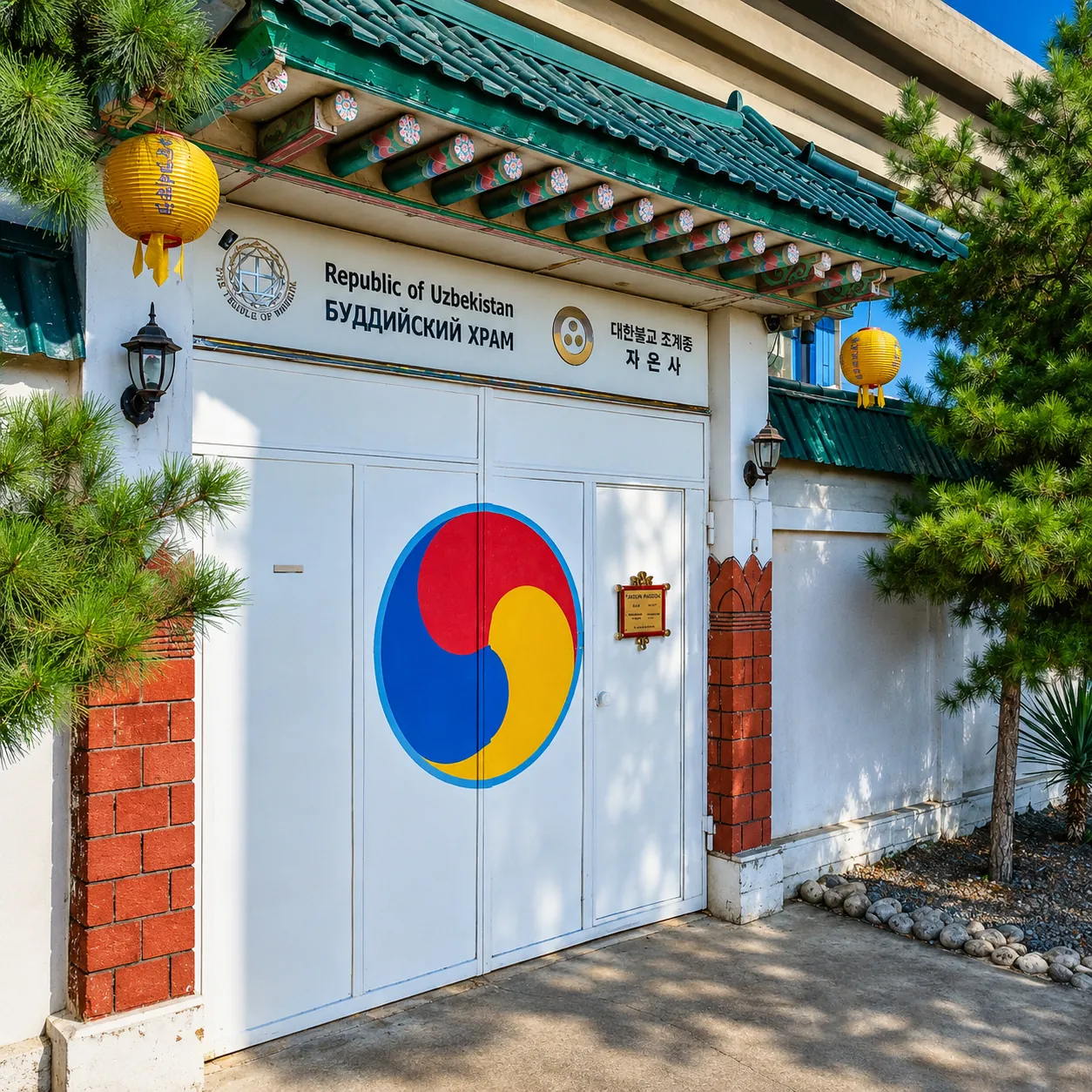
The painted Korean gate of Jaeunsa Temple, seen from the street The gate — what to look for on arrival · photo: Jaeunsa Temple
Name
Jaeunsa Temple · 자은사 — “Compassion”
Address
29/5 Tashkent Ring Road (TKAD), Sergeli district, Tashkent
Coordinates
41.241853, 69.276678
Tradition
Korean Zen (Seon), Jogye Order
Services
Sundays, followed by a shared meal
Abbot
Venerable Joju Sunim (Yang Ki-hoon), a monk from South Korea with a doctorate in history
Admission
Open to those interested in Buddhism, regardless of background or faith
Social media
@bud_uzb on Instagram

Phone number and current hours are in the 2GIS and Yandex Maps listings. On weekdays the temple may be empty: it is best to come on a Sunday or get in touch in advance.

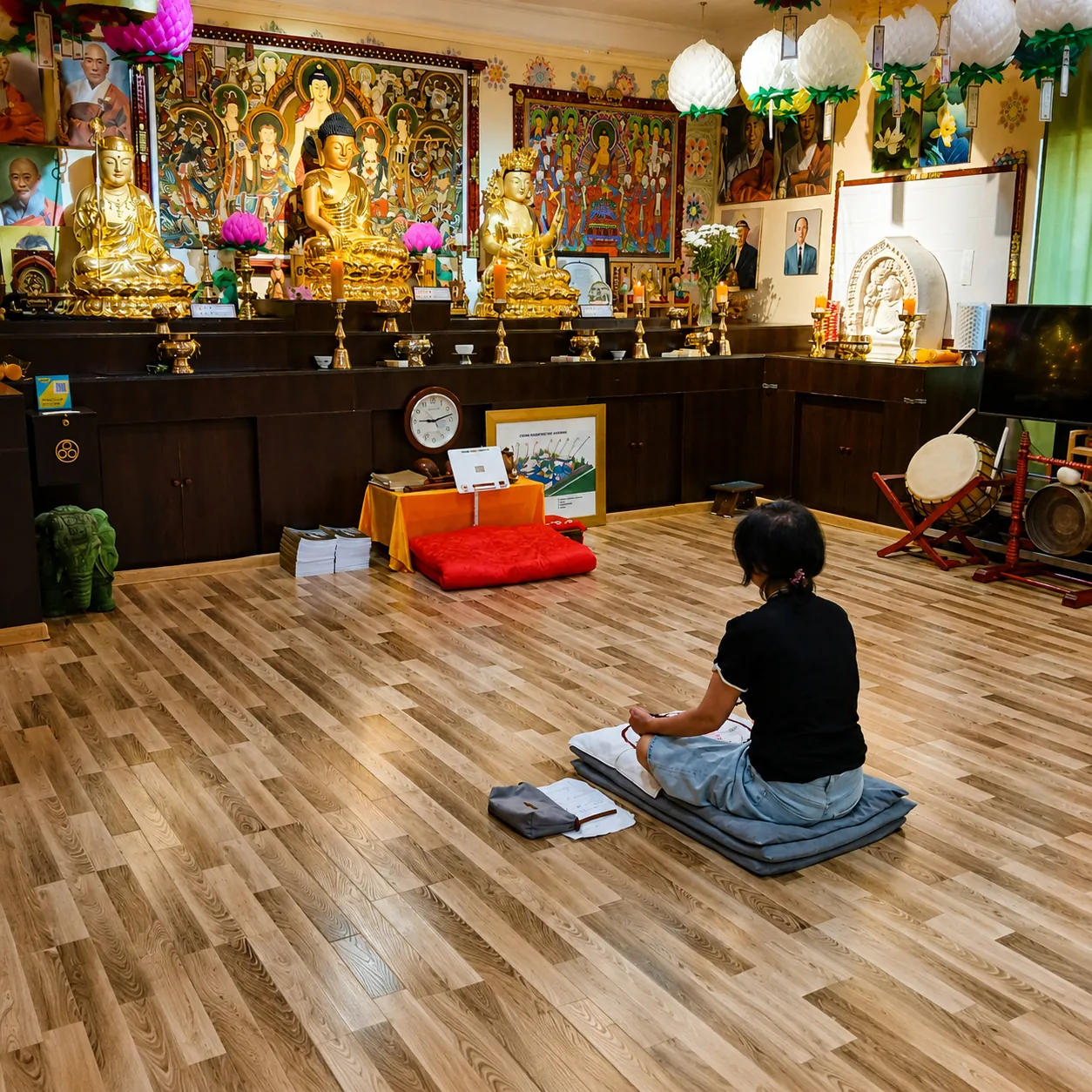
The meditation hall at Jaeunsa: cushions on the floor, wooden walls, the altar at the far end The meditation hall · photo: Jaeunsa Temple
What’s inside

A prayer hall, lanterns, books, a piano and a pond

Jaeunsa has the same rows of paper lanterns under its ceiling — they are hung for Buddha’s Birthday and left up for the year.

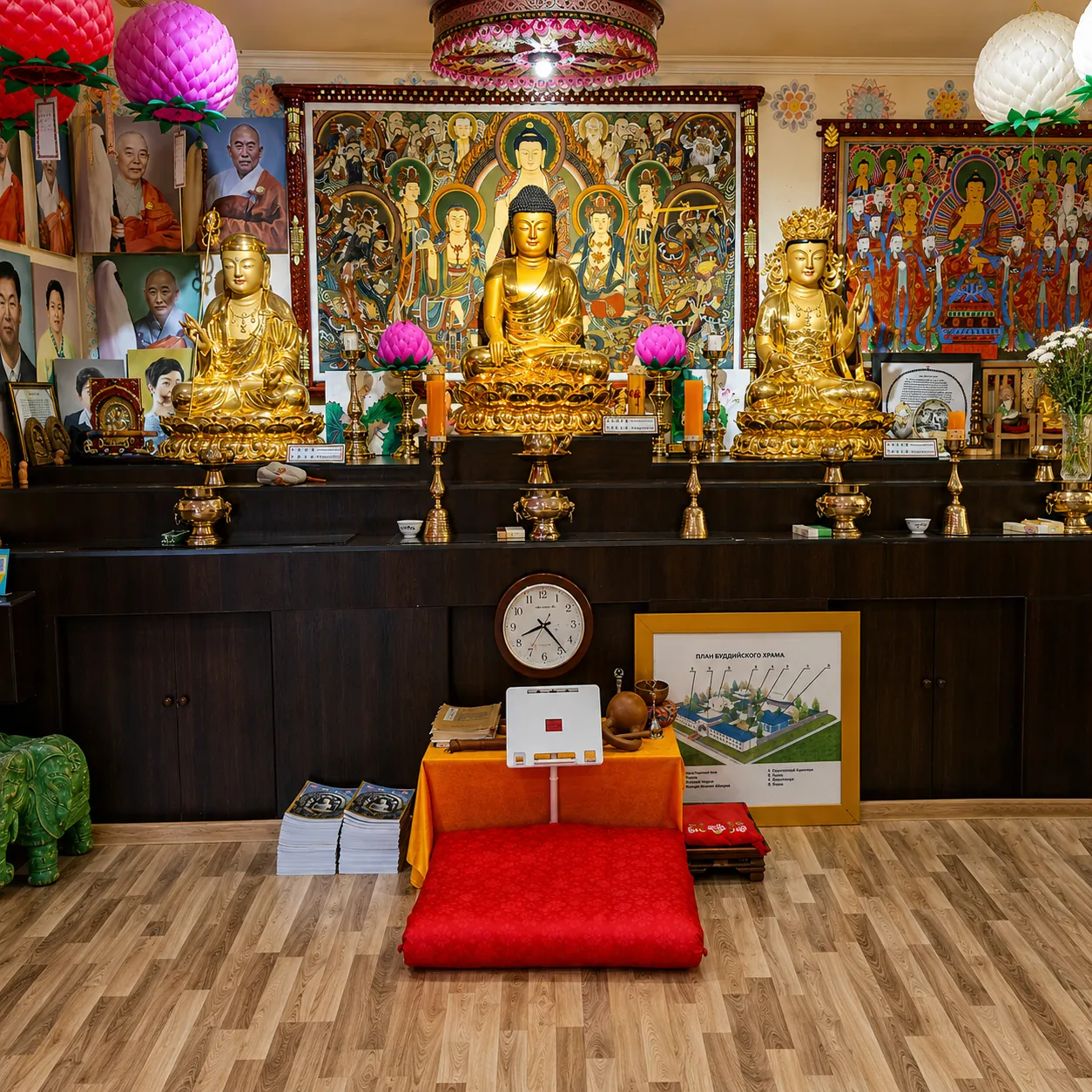
From the outside the temple is easy to miss: an ordinary fenced plot among private houses, with the elevated metro line between Sergeli and Kuylyuk running overhead. Inside, it is another world. A prayer hall with three golden statues, rows of bright paper lanterns beneath the ceiling, paintings on the walls, incense burners and candles.

Further in, shelves of books on Buddhism in Korean, Russian and English, old samovars, a piano. Behind the house is a Buddhist-style garden with trees and a fish pond. The community plans to add a separate ritual hall and administrative rooms.

The community was founded in the early 1990s by the Korean monk Yang Ki-hoon. Before ordaining he earned a doctorate in history and took part in archaeological expeditions to the Buddhist sites near Termez — which is how Uzbekistan became his home. In its early years the temple was in the city, on Vakhidov Street; in 2016 the community bought the current plot by the ring road.
Twice the temple came close to demolition — in 2018 when the road was widened, and in 2021 when the metro was built. Both times it was saved. Today trains pass directly over the garden.Impermanence in its purest form. The community still gathers on Sundays, as it did thirty years ago.
The altar at Jaeunsa: a Buddha statue, candles and offerings The main altar · photo: Jaeunsa Temple
When to visit

Sunday is the best day. May is the best month.

Sun · morning

Sunday service

The temple’s main rhythm. The service is in Korean with explanations in Russian, followed by a shared meal to which guests are usually invited too. This is the best day for a first visit: there will be people to answer your questions.

May

Buddha’s Birthday

The main holiday of the year is Vesak, on the full moon in May. In the morning there is a ceremony for the community: six offerings (lotuses, tea, fruit, flowers, rice) and the bathing of the Buddha statue with water. In the evening, a reception for guests — ambassadors and leaders of other faiths attend. More than a hundred people come.

weekdays

Quiet

On weekdays the temple is often empty — you can sit alone in the hall or the garden, but there may be no one to open the gate. If you are making a special trip, check in advance by calling the number in the map listing.

Etiquette

No complicated rules. Respect and quiet.

This is an active temple of the Korean tradition, not a museum. It is no disaster if you get something wrong — someone will show you the way. But a few things are worth knowing beforehand.

01

Shoes off at the door

You enter the hall without shoes, as in every Korean temple. Socks are a good idea.

02

Phone on silent

Photographing the hall is usually fine, but ask first. No photos during the service.

03

Modest clothing

Shoulders and knees covered. Nothing special is required.

04

Bowing is optional

Members of the community bow to the Buddha statue. For guests, a slight nod or simply standing quietly is enough.

05

Don’t point your feet at the statues

When sitting on the floor, don’t stretch your feet towards the altar. Otherwise sit however is comfortable — the lotus position is not required.

06

Offerings are not an obligation

There is a place for donations by the altar. Nobody checks, and nobody expects one.

07

Questions are welcome

The community is glad to see guests interested in Buddhism. Asking what a ritual means is perfectly normal.

08

You can just sit

No one will try to convert you. Coming in, sitting quietly for ten minutes and leaving is entirely acceptable.

Dancheong — traditional Korean painted decoration under the roof of a temple building, in green, red and white Dancheong — painted eaves, Seoul · photo: Brady Bellini, Unsplash
History

Buddhism is no guest here. It was here before Islam.

The land of present-day Uzbekistan was part of the Kushan Empire — the corridor along which Buddhism travelled from India to China. Jaeunsa is not an exotic import but a return.

1st–3rd c.

Karatepa and Fayaztepa near Termez — cave and surface monasteries of the Kushan era. The “Termez Buddhas” in Tashkent’s museums come from here.

3rd–4th c.

The Zurmala stupa near Termez — the largest surviving Buddhist monument in Central Asia, sixteen metres of brick.

5th–6th c.

By one account, Bodhidharma — the first patriarch of Zen — came from these parts: the area around Kitab in Kashkadarya.

1990s

Tashkent’s Korean community opens Jaeunsa Temple — the region’s first active Buddhist temple in many centuries.

Lanterns at Jaeunsa · photo: Jaeunsa Temple
Completely free · no subscriptions, no ads

So the service isn’t just a string of unfamiliar words

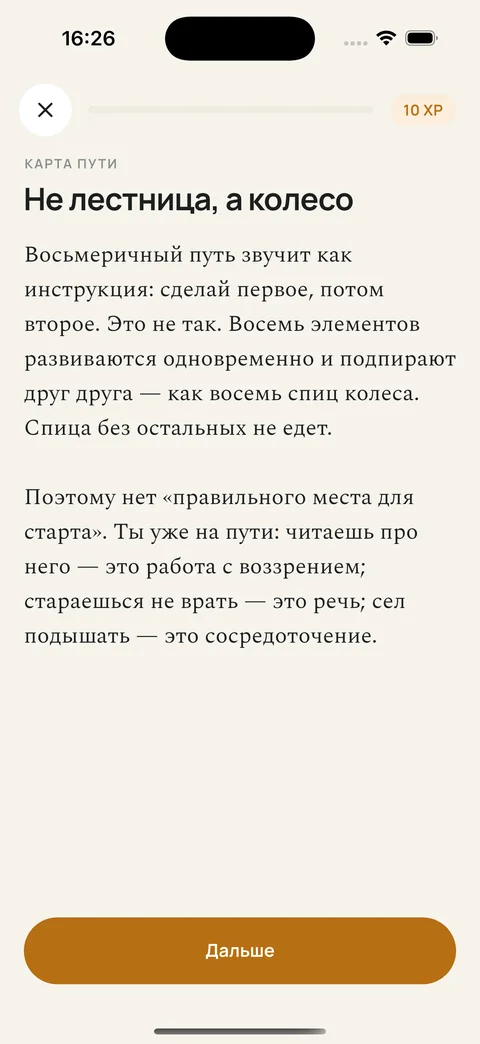
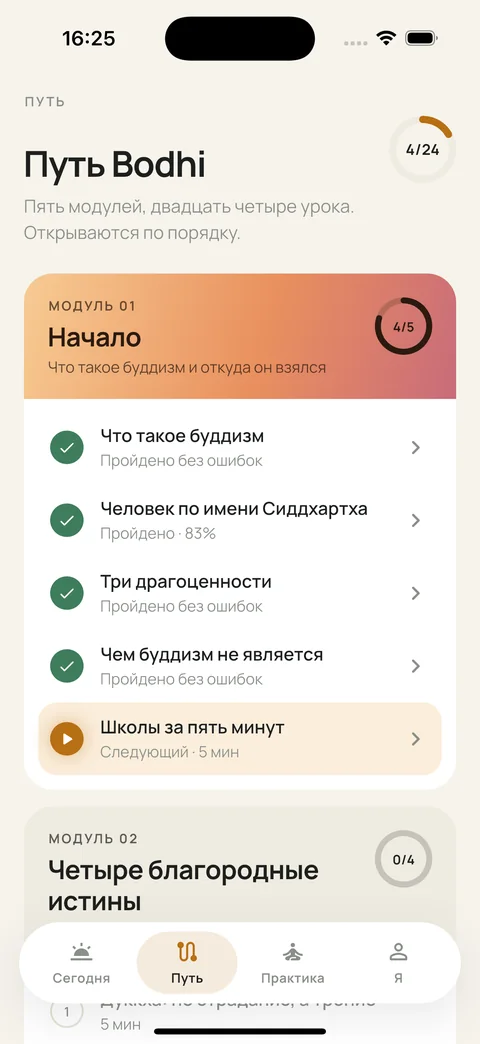
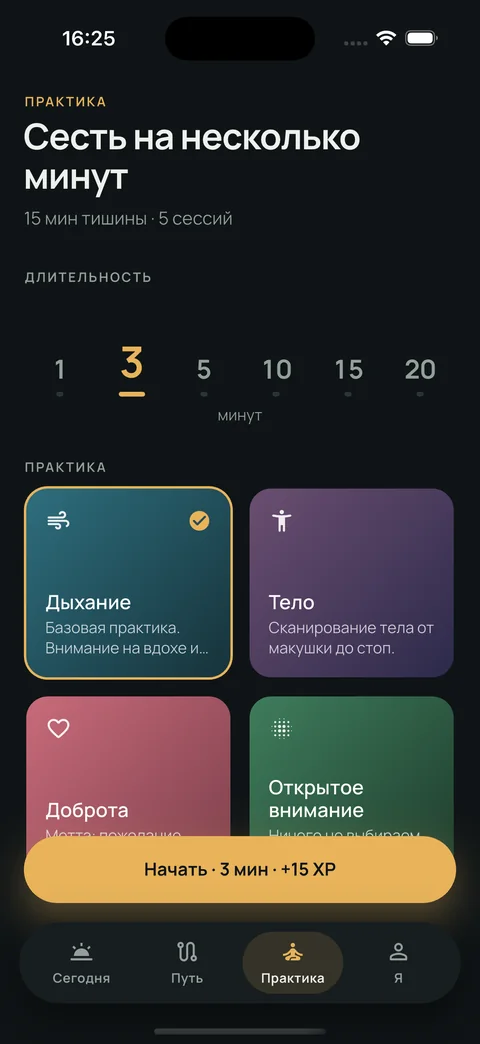
Bodhi is a free app that teaches the basics of Buddhism from scratch in five minutes a day: what the Dharma and the Sangha are, the Four Noble Truths, the Eightfold Path, how to sit in meditation and what Buddhist ethics rests on. Twenty-four lessons, and you will understand what is happening in the temple.

iPhone (iOS 15 and later) and Android · in English, Russian, Korean and Uzbek · free forever.

A lesson in the Bodhi app
The “Path” screen of the Bodhi app
Choosing a meditation practice in the Bodhi app
Questions

What people ask before a first visit

I’m not a Buddhist. Can I come?

Yes. The community says plainly that the temple is open to anyone interested in Buddhist culture and traditions. Most members are Tashkent Koreans, but guests of other nationalities and faiths visit regularly.

Is there an admission fee?

No. It is a temple, not a museum. Donations are voluntary.

What language is the service in?

Mostly Korean, with some explanations given in Russian. You can follow the general flow without knowing either language.

Can I learn to meditate there?

The temple’s tradition is Seon (Korean Zen), in which meditation is central. Ask about classes for beginners in person on a Sunday: the schedule changes.

Is this the only temple in Uzbekistan?

The only active one. There are ancient monasteries near Termez — Karatepa, Fayaztepa, the Zurmala stupa — but these are archaeological sites, not places of practice.